
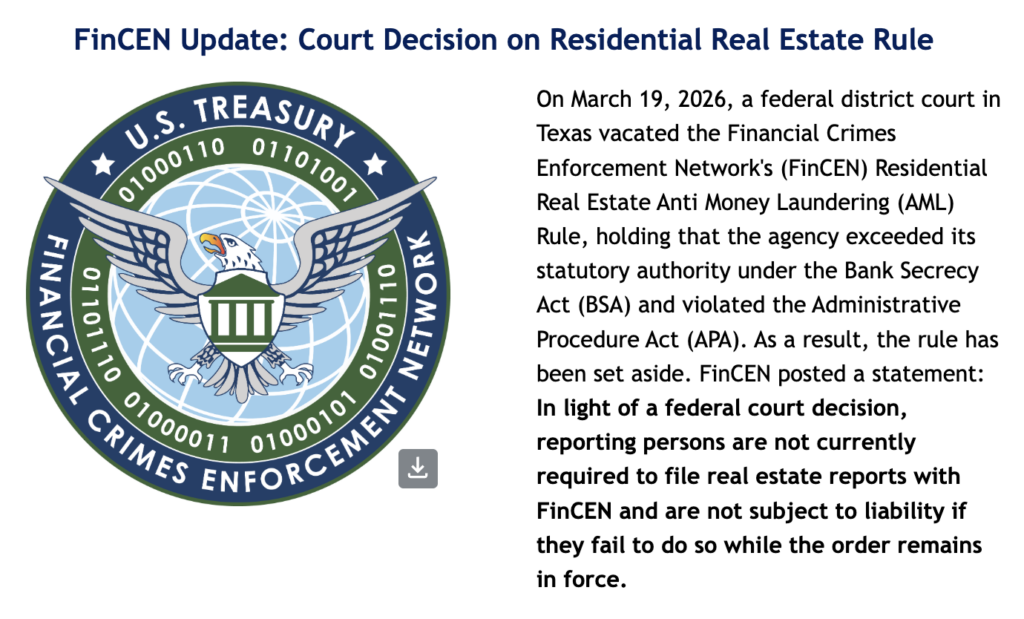
As of March 1, 2026, the U.S. Treasury’s Financial Crimes Enforcement Network (FinCEN) has activated its Anti-Money Laundering Regulations for Residential Real Estate Transfers (the “RRE Rule”). While this regulation is primarily directed at real estate closing professionals, it carries significant implications for family law practitioners—particularly those handling divorce settlements and property divisions involving trusts or entities.
What the Rule Requires
The RRE Rule mandates federal reporting for any non-financed (typically all-cash) transfer of residential real property to a legal entity or trust—including LLCs, corporations, partnerships, revocable trusts, and irrevocable trusts. Covered properties include one-to-four family homes, condominiums, cooperatives, and certain vacant land intended for residential use. The rule applies nationwide, replacing the prior Geographic Targeting Order (GTO) framework that was far more limited in scope. Hawaii practitioners familiar with the GTOs should take note of how dramatically the new rule expands reporting obligations. Under the GTOs, reporting was required only for non-financed purchases above $300,000 in Hawaii, and the obligation fell exclusively on title insurance companies—not attorneys or other closing professionals. The new RRE Rule eliminates the price threshold, extends reporting obligations beyond title insurers through a broader reporting cascade that can reach attorneys, and applies to all residential real estate markets nationwide. What was once a targeted, geographically limited anti-money laundering tool is now a comprehensive federal reporting regime.
A “Real Estate Report” must be filed no later than the last day of the month following closing, or 30 days after the closing date, whichever is later. The reporting party must retain a copy for five years. Responsibility for filing follows a “reporting cascade” typically landing on the settlement or title agent—but attorneys serving in a closing or settlement role may find themselves in the reporting chain.
Key Exemption Relevant to Family Law
The RRE Rule does include an exemption for transfers “incident to divorce”. No definition of the term is included in the regulation, but it would be wise to assume that it applies only to court-ordered transfers to a party.
Practice Implications for Hawaii Family Attorneys
Hawaii’s robust real estate market, high incidence of trust ownership, and concentration of high-value properties make these rules especially relevant here. Bear in mind the following when advising clients:
Divorce property settlements transferring real property into an LLC or trust may trigger reporting obligations unless a recognized exemption applies. Ensure divorce decrees and settlement agreements are precise in their language to preserve exemption eligibility.
Clients using trusts for privacy or asset protection should be advised that trust beneficial ownership information will now be reportable to federal authorities in applicable transactions.
Timing matters. Additional information gathering before closing is required, so build extra lead time into property transfer timelines in matrimonial matters.
Coordinate with title professionals early in the transaction to confirm who bears reporting responsibility and whether an exemption applies.
A Cautionary Hypothetical
Consider this scenario: Spouse 1 and Spouse 2 own a home jointly. As part of a divorce settlement, a friend or family member of Spouse 1 purchases Spouse 2’s interest for cash, with that interest taken into a trust, making the friend/family member and Spouse 1 co-owners. Is this reportable? Almost certainly yes — and the divorce exemption very likely does not apply.
The RRE Rule focuses on the nature of the transfer, not the surrounding circumstances. Here, the reportable event is Spouse 2 conveying a real property interest to a third-party trust for cash consideration. That is a textbook covered transaction. The divorce exemption requires that the transfer occur by reason of divorce or court order — but this transfer is between Spouse 2 and an unrelated third party, for valuable consideration. It looks like a conventional sale. The fact that it arises out of a matrimonial action probably does not bring it within the exemption, even if a family court approved the arrangement.
The lesson: do not assume the divorce exemption travels with a transaction simply because it arises in a matrimonial context. The exemption attaches to the nature of the transfer, not the circumstances of the parties. Attorneys structuring third-party buyouts, deferred sales, or other creative settlement arrangements involving trusts or entities should perform a fresh reportability analysis for each discrete transfer — and coordinate with the title professional before closing to confirm who bears the reporting obligation.
Penalties for Noncompliance
The consequences for failing to comply with the RRE Rule are serious and should not be underestimated. Enforcement authority flows from the Bank Secrecy Act, and FinCEN has signaled that it intends to prioritize enforcement. On the civil side, penalties can reach up to $1,394 per violation, with higher amounts possible where negligence is involved. Notably, this civil penalty figure is per day—meaning ongoing or undetected failures to file can compound quickly. The willful failure to report, or the willful submission of false or misleading information, triggers criminal exposure: criminal fines of up to $250,000 and up to five years in prison.
For family law attorneys, the most immediate risk arises when an attorney serves as the designated “reporting person” in a covered transaction—for example, when handling the recordation of a deed transferring property into a third party trust or LLC as part of a divorce settlement. The attorney recording the deed is responsible for reporting the transaction under the Reporting Cascade. An attorney who fails to recognize a reportable transaction, or who mistakenly assumes an exemption applies, could face direct liability. Frankly, there is not much to recommend assuming the risk of a violation rather than running property transfers through escrow.
Reliance on a client’s assurances alone is not a defense.
Reporting persons may rely on information provided by any other person, but only if the reporting person does not have knowledge of facts that would reasonably call into the question the reliability of that information.
Professionals who choose to act as reporting parties should maintain thorough records of compliance activities, including training and internal audits, as well as copies of all designation agreements and beneficial ownership certifications for at least five years. Documentation of your compliance process—evidence that you assessed reportability, confirmed exemption eligibility, or properly delegated reporting responsibility—will be essential if FinCEN ever scrutinizes a transaction. The takeaway: treat reportability analysis as a mandatory step in every divorce-related real property transfer involving an entity or trust, not an afterthought.